


Infrared Heating for Care Homes: A Safer, More Efficient Alternative
Heating a care home is unlike heating almost any other type of building. The system runs 24 hours a day, 365 days a year. It needs to keep vulnerable residents safe and comfortable in every room, at every hour, regardless of the weather outside. And it typically accounts for up to 70% of the building’s total energy costs.
On top of that, every radiator in the building needs a guard or Low Surface Temperature (LST) casing to protect residents from burns. It’s the right thing to do — and in most cases it’s a regulatory requirement.
But those guards come at a cost that rarely gets talked about.
- They restrict airflow across the radiator surface, reducing heat output.
- They add purchase and installation costs to every radiator in the building.
- They collect dust, which in care environments has been found to contain MRSA and other potentially pathogenic organisms that are then dispersed into the room when the heating comes on
The result is a cycle that’s difficult to break. Higher gas consumption leads to higher bills, which tighten already-thin operating margins, which put pressure on everything else like staffing, maintenance and quality of care. And all of it stems from a heating system that was designed for a different era.
Infrared heating offers a fundamentally different approach. One that removes the need for radiator guards entirely, gives staff room-by-room temperature control, improves air quality for residents, and eliminates the ongoing maintenance burden of boilers and pipework.
This guide explains how it works and why it’s becoming an increasingly popular choice for care homes across the UK.
The Hidden Cost of Keeping Residents Safe
Nobody questions the need for radiator guards in a care home. Residents with limited mobility, reduced sensation, cognitive impairment or dementia are at genuine risk of burns from hot radiator surfaces. Guards and LST casings exist to prevent that, and they do their job.
The Guard Tax on Your Heating
The problem is what guards do to heating performance. A radiator heats a room by warming air as it passes across the heated surface. Wrap that surface in a guard or casing and you restrict that airflow, which means less heat reaches the room. How much output is lost depends on the design of the guard: solid wooden covers block the most, basic mesh guards less so, and premium LST casings with reflective backing claim to minimise the impact. But even in the best case, you’re adding a barrier between the heat source and the room, and the radiator is working harder than it would without one.
Then there’s the hygiene issue. Guards create enclosed spaces around radiators where dust, lint, and debris accumulate. In a care home, that dust has been found to contain MRSA and other potentially pathogenic organisms. When the heating comes on, convection currents disperse that dust (and whatever it’s carrying) into the room. Guards need regular cleaning to manage this, adding another task to an already stretched maintenance schedule.
And all of this cost, compromise and maintenance exists for a single reason: the radiator is hot and it’s within reach of vulnerable residents. Ceiling-mounted infrared panels remove that problem at the source. No hot surface at hand height means:
- No guard needed
- No restricted airflow
- No dust trap, and
- No compromise on heat output.
The Maintenance Burden
Beyond the guards, a centralised gas heating system carries its own weight of ongoing costs and compliance. Annual boiler servicing is mandatory. Emergency callouts when the boiler fails — often at the worst possible time — are expensive and disruptive.
Legionella risk assessments on the hot water system add another layer of compliance. Ageing pipework in older care home buildings develops leaks, airlocks, and cold spots that are expensive to diagnose and repair.
And when the boiler does go down, the entire building is affected. Every room, corridor, communal space goes cold at once. A serious welfare concern when your residents are elderly and vulnerable.
Why Infrared Changes the Equation
Instead of heating air and circulating it through guarded radiators, infrared panels warm surfaces, objects and people directly. It’s the same way the sun warms you on a cool day. The practical implications for a care home are significant.
Ceiling Mounting Removes the Need for Guards
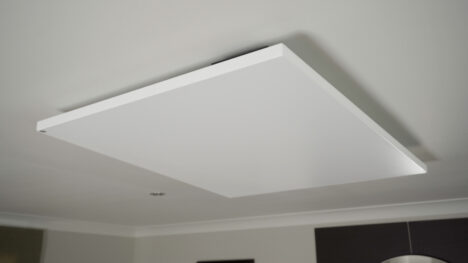
This is the single biggest advantage for care homes. Infrared panels mount to the ceiling, flat against the surface, completely out of residents’ reach. There’s:
- No hot surface at hand height
- No guard needed
- No LST casing needed
- No obstruction to heat output
Every watt the panel produces reaches the room. There’s no compensating by running the system harder. The heating works at full efficiency because nothing is getting in the way.
In risk assessment terms, ceiling-mounted panels move the heating from Priority 1 (accessible hot surface requiring protection) down to Priority 3. Burns, trips over guards, and contact injuries are removed from the equation in one step.
Better Air for Vulnerable Residents
Convection heating, whether from radiators, fan heaters, or ducted systems, works by warming the air and circulating it around the room. That moving air carries dust, allergens, skin particles, and airborne pathogens with it.
In a care home, where many residents have COPD, asthma, or compromised immune systems, this is a genuine clinical concern.
Infrared panels don’t move air at all. There’s no fan, no convection current, no dust being blown from one side of the room to the other. The air stays still and clean. Residents with breathing difficulties aren’t inhaling heated, dry, particle-laden air. The environment is calmer, quieter, and healthier.
This matters for staff too.
Care England data shows that adult social care lost 7.2 million working days to staff sickness in 2023–24, costing providers over £120 million annually in overtime, sick pay, and agency cover. Better air quality won’t solve all of that, but a healthier indoor environment contributes to fewer respiratory complaints, fewer sick days, and a more comfortable workplace.
For more on this, see our article on how far infrared promotes a healthier environment.
Every Room on Its Own Schedule
- Mrs Davies in Room 12 feels the cold and wants her room kept warm all day.
- Mr Patel in Room 8 overheats easily and prefers it cooler.
- The main lounge needs to be comfortable for 20 people sitting still for hours.
- The corridor connecting them doesn’t need heating at all.
With a centralised gas system, this is almost impossible to manage well. The boiler fires, the whole building heats up, and individual preferences get lost in the system. Fitting thermostatic radiator valves helps, but they’re imprecise, often tampered with, and can’t turn a room off entirely.
Infrared gives each room its own panel, its own thermostat, and its own schedule, completely independent from every other room in the building. Staff can set Room 12 to 22°C and Room 8 to 19°C without one affecting the other. The dining room can warm up before mealtimes and cool down after. Unoccupied bedrooms can be switched off entirely until a new resident arrives.
Smart controllers take this further. A facilities manager can monitor and adjust every room in the building from a single device, whether it’s a phone, a tablet, or a desktop.
For a full breakdown of the control options, see our guide to infrared heating controllers.
No Boiler, No Servicing, No Legionella Risk
Infrared panels are fully electric. There’s no gas supply, boiler, pipework, or hot water storage associated with the space heating system. That eliminates a significant chunk of ongoing maintenance and compliance.
If an individual panel ever fails, which is rare, given that they have no moving parts, only that one room is affected. Every other room in the building continues to heat normally. It’s the difference between a localised inconvenience and a building-wide emergency.
Lower Running Costs
The cost argument for infrared in a care home isn’t simply “electricity vs gas per kWh” because electricity does cost more per unit than gas. The argument is about total system efficiency and total cost of ownership.
With infrared:
- You’re not losing your heat output to radiator guards.
- You’re not heating corridors, empty rooms, and utility areas on the same schedule as occupied bedrooms.
- You’re not paying for annual boiler servicing, emergency callouts, and Legionella compliance tied to the heating circuit.
- And you’re not running a boiler at full capacity 24 hours a day because the system has no concept of which rooms actually need heat.
Zonal control alone can make a dramatic difference. A care home with 40 bedrooms might only have 30 occupied on a given night. With infrared, those 10 empty rooms are off. With a centralised system, they’re heated along with everything else.
For care homes with roof space, pairing infrared with solar PV takes the economics further, generating the electricity that powers the panels and reducing dependence on grid pricing.
Where It Works Best in a Care Home
Resident Bedrooms
Each bedroom gets its own ceiling-mounted panel with its own thermostat. The panel sits flush against the ceiling which is barely noticeable once installed.
White panels blend into a white ceiling seamlessly. Picture panels can add colour or a calming image to the room, like a landscape, a garden scene, a piece of art. This turns the heater into something that enhances the room rather than something that needs to be guarded.
Operation is completely silent. For residents who are light sleepers or easily disturbed, this matters.
Communal Lounges and Dining Areas
Larger spaces may need multiple panels for even coverage, sized to the room’s dimensions and insulation.
Programmable timers mean the lounge is warm and comfortable when residents arrive in the morning, stays at a consistent temperature through the day, and drops back when the room empties in the evening. The dining room warms up before meals and cools down after, rather than being heated to the same level as a bedroom 24 hours a day.
Bathrooms and En-Suites
IP-rated infrared panels are designed for use in wet environments.
Mirror panels are a particularly practical choice for care home bathrooms. They heat the room, serve as a mirror for residents and carers, and prevent the glass from steaming up after bathing.
They also help reduce condensation on walls and surfaces, which in turn reduces the conditions that allow mould to develop.
Corridors and Hallways
In most care homes, corridors are heated to the same temperature as bedrooms because they’re on the same central heating circuit. That’s a significant waste of energy as corridors are transient spaces where people spend seconds, not hours.
With infrared, corridors can be heated independently at a lower temperature, or in some cases not heated at all. If the bedrooms and communal areas either side are warm, the corridors benefit from residual warmth without needing their own dedicated heating. The savings from this alone can be substantial across a large building.
Staff Areas and Offices
Staff rooms, offices and nurse stations can be controlled independently from resident areas. Staff can set their own comfortable temperature without affecting the residents’ environment.
Installation: New Build vs Retrofit
New Build or Major Refurbishment
If you’re building a new care home or undertaking a significant refurbishment, specifying infrared from the design stage is the most cost-effective approach. Panels can be wired in during the electrical first fix, positioned precisely where they’ll perform best, and integrated with a building-wide smart control system from day one.
There’s also a meaningful saving on the build itself. Because there’s no radiator pipework to install throughout the building, no boiler room to design and no LST radiators or guards to source and fit.
The mechanical services element of the build becomes simpler and cheaper.
Retrofit into an Existing Care Home
For existing care homes, infrared is one of the least disruptive heating upgrades available.
Panels mount to the ceiling using standard fixings. The electrical work, either a plug-in connection or a hardwired spur, is straightforward. A single room can typically be fitted in under an hour.
Critically, rooms don’t need to be taken out of service for extended periods. For a care home that can’t afford to close a wing for a week, that matters.
Phased Rollout
Many care homes take a phased approach. This means fitting one floor or one wing with infrared first, measuring the results over a heating season, and then rolling out across the rest of the building.
This reduces upfront cost, proves the concept in a real-world setting, and lets staff and residents experience the difference before committing to a full changeover. It also means the existing heating system can remain operational in the unrefurbished areas during the transition.
Common Questions from Care Home Operators
Is infrared heating suitable for CQC-regulated care homes?
Yes. The CQC doesn’t endorse specific heating technologies, but it does assess whether the physical environment is safe, well-maintained, and suitable for residents’ needs under Regulation 15.
Ceiling-mounted infrared panels support those requirements: they remove the burn risk associated with accessible radiators, contribute to better air quality, and offer individual room temperature control. They also eliminate the risk of a single boiler failure leaving the entire building without heating, a scenario the CQC has flagged as a serious safety concern.
Can it heat a large communal lounge effectively?
Yes, with correctly sized panels. A large lounge will need multiple panels to provide even coverage, but the sizing calculation is straightforward. It’s based on room dimensions, insulation quality, and ceiling height. Use our free calculator for a recommendation or get in touch and we’ll assess the space for you.
What about hot water?
Infrared replaces space heating, the radiators, guards, and associated pipework. It doesn’t replace your hot water supply. The existing hot water system remains in place or can be upgraded separately with an appropriate solution such as a heat pump, point-of-use heaters, or an electric boiler.
How does it compare to heat pumps?
They solve different problems. Heat pumps are a like-for-like replacement for a gas boiler. They heat water that’s pumped through radiators or underfloor pipes. They’re efficient but require significant upfront installation, external space for the unit, and in some cases the same radiator guards you’re trying to eliminate.
Infrared replaces the radiators themselves with direct radiant heat from the ceiling. In some care homes, a combination of both, heat pump for hot water and infrared for space heating can be the most effective overall solution.
What are the running costs compared to gas?
Electricity costs more per kWh than gas, that’s a fact. But the total cost comparison needs to account for what you’re actually paying for with gas: the heat loss through radiator guards, heating unoccupied rooms on a whole-building schedule, annual boiler servicing, emergency callouts, Legionella compliance, and ongoing pipework maintenance.
When those costs are factored in, the total cost of ownership with infrared is often competitive, and in care homes with good zonal control discipline, it can be lower.
Can staff override the controls if a resident is uncomfortable?
Yes. Room-level thermostats can be adjusted by staff at any time. Smart controllers also allow a central override from a phone or tablet, so a nurse on duty can adjust a resident’s room temperature without leaving the nurse station. The system is designed to give care staff more control, not less.
What happens if a panel fails?
Only that one room is affected. Every other panel in the building continues to operate independently. There’s no single point of failure like a boiler breakdown that takes the entire building offline. A replacement panel can be fitted quickly without disrupting the rest of the heating system, and with no moving parts, panel failures are extremely rare. Most come with warranties of 10 years or more.
Ready to Explore Infrared for Your Care Home?
Browse our commercial infrared heating range to see panels suited to care home environments.
Get in touch with our team to discuss your care home’s specific requirements. We work with care home operators across the UK and can advise on sizing, phased rollout, and the right control setup for your building.

Written by Ben
The Right Heater For You
Find the best heater for you with our infrared heating calculators.
Find now