


Ofgem confirmed today that the energy price cap will be £2,166 a year for a typical home from 1 January, up 26% on the current cap. If you’re already watching your bills closely, that’s not what you wanted to hear.
But if your real problem is one cold room, rather than a whole cold house, the headline number tells you less than you might think. Here’s a calm look at what’s changed and what it means for you.
What’s Changed, in Plain Numbers
The new cap starts on 1 January 2027 and runs until the end of March. Here’s how it compares with what you’re paying now, if you pay by Direct Debit.
| Now (1 Oct to 31 Dec 2026) | From 1 Jan 2027 | |
|---|---|---|
| Typical annual bill (gas and electricity) | £1,723 | £2,166 |
| Electricity unit rate | 26.32p per kWh | 32.69p per kWh |
| Electricity standing charge | 54.83p per day | 54.77p per day |
| Gas unit rate | 7.97p per kWh | 10.96p per kWh |
| Gas standing charge | 29.68p per day | 29.65p per day |
Source: Ofgem. Rates are averages and vary slightly by region.
One thing worth knowing is that the cap limits the price you pay for each unit of energy and the daily standing charge. It doesn’t cap your total bill. Use more and you’ll pay more; use less and you’ll pay less.
Why the Headline Figure Isn’t Your Figure
The £2,166 figure is based on what a typical home uses across a whole year. That’s a household heating every room through the winter.
Your bill depends on what you actually heat, and for how long. If you’re running the whole central heating system just to make one spare room, home office or extension bearable, most of that heat goes to rooms you’re not sitting in. That’s the part of your bill you have the most control over.
What it Costs to Heat One Room
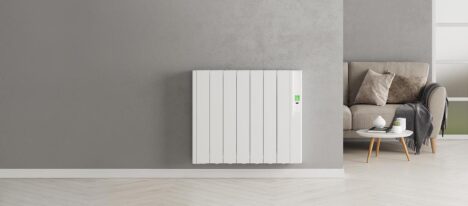
The maths is simpler than you might expect. Take a 660W infrared panel, a sensible size for a small home office or bedroom of around 3m by 3m.
- At full power it uses 0.66 kWh an hour.
- At the new rate of 32.69p per kWh, that’s about 22p an hour.
- Four hours of heating a day comes to about 86p.
For comparison, at the current rate of 26.32p per kWh, the same panel costs about 17p an hour, or 69p for four hours.
In practice you’ll usually pay less than that. With a thermostat, your panel switches off once the room reaches your chosen temperature, then switches back on only when it needs to. So it won’t run at full power for the whole four hours. How much less depends on your room, your insulation and the temperature you like.
Not sure what size you need? Our heating calculator works out the right wattage for your room and estimates your running costs.
Gas vs Electric, Honestly
We’ll be straight with you: per unit, gas is still cheaper than electricity. Under the new cap you’ll pay 10.96p per kWh for gas and 32.69p for electricity, so each unit of electricity costs roughly three times as much.
There is some useful context, though. Electricity carries no VAT this winter, and it stays at 0% until the end of June 2027. Gas still has 5% VAT.
But the real question isn’t which unit is cheaper. It’s whether you need to run your whole heating system to fix one room. A boiler warms every radiator on the circuit. An infrared panel warms only the room you’re in, and only while you’re in it. That targeting is where electric heating can help keep your usage down.
If you’re weighing up bigger changes to your home’s heating, our guide to infrared heating vs heat pumps walks you through the differences.
Five Sensible Things to Do This Week
- Submit a meter reading before 1 January. It means you’re billed at the old rate for energy you used in December, not the new one.
- Check whether a fixed tariff beats the cap. Some suppliers offer fixed deals below the new cap. Compare the unit rates and exit fees before you switch.
- Find the draughts in your cold room. Check around windows, doors, skirting boards and loft hatches. Cheap draught strips can make a noticeable difference to how warm the room feels.
- Set your thermostats and timers. Heat rooms only when you’re using them, and to a temperature that feels comfortable rather than hot.
- Check the support you’re entitled to. If you live in England in council tax bands A to D, you may qualify for the £100 Household Energy Payment. Your supplier can also tell you about other help available.
The Bottom Line
Your bills are going up in January. But if your problem is one cold room, you have more control over that cost than the headline suggests. Heat the space you use, for the hours you use it, and let a thermostat do the rest.
We’ve been helping UK homes with exactly this since 2014, and our customers rate us 4.8 out of 5 from more than 1,400 reviews on Trustpilot
Not sure which panel suits your room? Give the team a call on 01205 821 796 and we’ll help you work it out.
You can also get in touch online, or use our heating calculator to see what your room needs and what it could cost to run.