


Is Infrared Heating Good For Damp Walls?
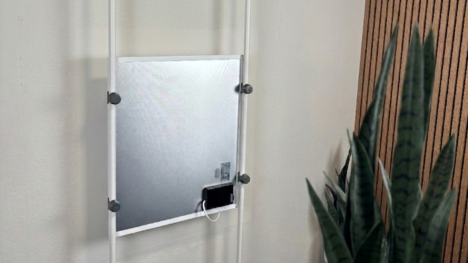
Far infrared heating is one of the most effective ways to stop condensation damp on walls.
Infrared panels warm the wall surface itself, raising it above the ‘dew point’ so moisture can no longer settle. Over time, this
- Dries out damp masonry.
- Removes the conditions mould needs to grow.
- Keeps walls permanently warmer with lower running costs than most conventional heaters.
If you’re dealing with damp patches, black mould in the corners of rooms, or condensation streaming down your windows every morning, you’re not alone. Government estimates suggest anywhere from one to six million homes in England have a damp or mould problem.
If you’ve already tried wiping down walls, running dehumidifiers, and repainting with anti-mould paint only to watch it come back again, you already know those are sticking plasters, not solutions.
The good news is that infrared heating tackles the actual cause, not just the symptoms. Here’s how it works, what it can realistically do, and how to choose the right panels for your home.
Why Damp Forms on Your Walls in the First Place
To fix damp properly, it helps to understand why it’s there. Most damp on interior walls, particularly in bedrooms, bathrooms, and north-facing rooms, is condensation damp. It’s the most common type in UK homes.
Every room in your house contains moisture in the air. Cooking, showering, drying clothes, even breathing all add water vapour. That moisture stays invisible as long as the air is warm enough to hold it. The problem starts when that warm, moist air meets a cold surface.
This is where a concept called the dew point matters. The dew point is the temperature at which air can no longer hold its moisture and water starts to condense out as liquid droplets, exactly like a cold glass of water “sweating” on a summer day. In a typical UK home at 20°C with 50% relative humidity, the dew point sits at roughly 9°C. Any wall surface colder than that will collect condensation.
External walls, corners where two outside walls meet, window reveals, and cold lintels are almost always the coldest surfaces in a room. Thermal imaging studies consistently show these spots reading 3-8°C cooler than mid-wall areas. That’s why mould always seems to appear in the same places; the corners, behind wardrobes, and around windows, regardless of how much you clean it.
Traditional convection heaters (radiators, fan heaters, storage heaters) warm the air. But warmer air actually holds more moisture, and that moisture-laden air then migrates to the coldest surfaces in the room, where it dumps its water. In many cases, convection heating can actually make condensation worse.
How Infrared Heating Solves Damp on Walls
Infrared heating works on a fundamentally different principle. Instead of warming the air, far infrared panels emit radiant energy that is absorbed directly by solid surfaces.
This matters for three specific reasons.
- It raises wall surface temperature above the dew point: When an infrared panel heats your external wall, the surface temperature climbs above the dew-point threshold. Condensation can’t form on a warm surface. The problem stops at its source.
- It drives moisture out of masonry: Far infrared energy is absorbed by water molecules within the wall. This gently warms moisture trapped inside bricks, plaster, and mortar, turning it into vapour that migrates outward through the wall and dissipates. Especially when paired with adequate ventilation like trickle vents or an extractor fan. Over a period of weeks, damp walls progressively dry out.
- It stores heat in the building fabric: Unlike convection heat, which escapes the moment you open a window, infrared energy is absorbed into the thermal mass of your walls and furniture. These surfaces then continue to re-radiate warmth back into the room even after the panel has cycled off. This “thermal battery” effect means your walls stay warmer for longer, the panel runs less, and your electricity bills stay lower.
In a real-world flood recovery, Warm4Less supplied six 600W panels to a property with severely waterlogged walls. Over ten weeks of continuous operation, the panels evaporated thousands of litres of trapped water, prevented mould from establishing, and saved an estimated £30,000 compared to conventional strip-out and rebuild costs.
What Infrared Can (and Can’t) Do for Damp
Infrared heating is very effective for certain types of damp, but it’s not a magic wand for every situation.
- Condensation Damp: Infrared is Ideal – This is by far the most common form of damp in UK homes and the one solve. By keeping walls warm and dry, you remove the conditions condensation and mould need entirely.
- Penetrating Damp: Infrared Helps After Fixing the Main Cause – If rainwater is getting through a cracked render, failed pointing, or a leaking gutter, an infrared panel will dry the wall out, but only once you’ve repaired the external defect. Without fixing the source, water will keep coming in faster than any heater can dry it out.
- Rising Damp: Infrared Helps After a Damp-Proof Course is Repaired – Capillary action drawing ground moisture up through bricks needs a physical barrier (a DPC) to stop it. Once that’s in place or repaired, infrared is an excellent way to dry the wall back out and keep it dry going forward.
- Mould Prevention: Infrared Removes the Conditions Mould Needs – Mould spores need surface moisture, cold temperatures, and still air to colonise. Infrared eliminates the first two. However, it doesn’t sterilise existing mould. You’ll still need to clean affected areas with a fungicidal wash before installing panels, then let infrared prevent it from returning. For active mould problems, the MouldClear range offers freestanding panels you can aim directly at the worst-affected areas to dry them out fast.
One Thing to Be Aware of: Placement Matters
Infrared heats surfaces in its line of sight. If a large piece of furniture blocks panel’s view of a cold wall, that wall stays cold, a phenomenon sometimes called a “heat shadow.”
This is easily solved with thoughtful panel placement (opposite the problem wall, or mounted on the ceiling for full-room coverage) and by leaving a small gap between furniture and external walls.
How to Choose and Place Panels for Damp Walls
Getting the right results depends on choosing the correct wattage and positioning your panels properly. Here’s a practical guide.
Sizing For Damp-Prone Rooms
For general comfort heating in a well-insulated room, around 50W per square metre of floor area is a reliable rule of thumb. But damp-prone rooms, older properties with solid walls, poor insulation, north-facing bedrooms, ground-floor flats, need more. For these spaces, increase to 100-150W per square metre to ensure you’re lifting the wall surface temperature high enough above the dew point to make a real difference.
We have a free online wattage calculator that factors in room dimensions to recommend the right panel setup for your space.
Where to Mount Infrared Heating Panels
For damp and mould problems specifically, positioning is just as important as wattage.
- Wall-mounted, on the opposite wall: Mount the panel on an internal wall facing the damp external wall. The infrared travels across the room and heats the problem surface directly. This is the most common setup.
- Ceiling-mounted: This is the strongest option for rooms with damp in multiple corners or on more than one wall. A ceiling panel radiates downward onto every surface in the room, eliminating cold spots and heat shadows. It also frees up wall space entirely.
Avoid placing panels on the damp wall itself. You want the infrared to travel to the cold surface, not radiate away from it.
Room-by-Room Considerations
- Bathrooms – generate enormous amounts of moisture daily. IP-rated mirror panels or towel rail heaters are purpose-built for this environment. They prevent condensation on tiles and mirrors while keeping the room warm. Always pair with an extractor fan.
- Bedrooms – particularly north-facing ones, are condensation hotspots because we produce moisture through breathing overnight while the heating is usually off. A programmable panel (like the Eco range with its built-in controller) can maintain a low background temperature overnight to keep walls above dew point without running up costs.
- Kitchens produce steam from cooking and washing up. A ceiling-mounted panel avoids interference from cabinets and appliances while keeping walls and ceiling surfaces warm.
- Living rooms and hallways in older properties often have cold chimney breasts and external corners. Wall panels mounted opposite these cold spots work well here and the picture panels double as wall art.
MouldClear Panels: Targeted Mould Removal
If you already have a visible mould problem and want to tackle it head-on before it spreads further, Warm4less has developed a product specifically for this purpose. The MouldClear range is a freestanding infrared heater designed to be aimed directly at damp and mould-affected areas, drying them out at the source.
Unlike wall-mounted or ceiling panels that provide whole-room heating, MouldClear panels are portable and freestanding with adjustable-height stands, so you can position them precisely where the problem is worst. Point one at a mould-affected corner, a damp patch behind a wardrobe, or a waterlogged wall section, and the far infrared energy gets to work drying the masonry and eliminating the conditions mould needs to survive.
The range comes in two sizes:
- 450W MouldClear – A compact 720 × 620mm panel ideal for targeting individual damp patches in bedrooms, bathrooms, or small rooms. Weighs just 3.7kg so it’s easy to move between problem areas as needed.
- 700W MouldClear – A larger 1220 × 620mm panel with more power for bigger affected areas, larger rooms, or more severe damp problems.
Both models feature an in-built controller with a handheld remote, so you can set your preferred operating schedule and let the panel work on a timer. They’re IP54-rated for use in moisture-prone environments like bathrooms and kitchens, carry a 5-year warranty, and have a carbon crystal heating element. No installation is needed – simply assemble the freestanding stands, plug in, and point the panel at the affected wall.
MouldClear panels work brilliantly as a first-response tool to dry out an active damp or mould problem, and pair well with a permanent wall-mounted or ceiling panel for long-term prevention once the worst of the moisture has been dealt with.
The Cost of Doing Nothing
Damp doesn’t stay static. Left untreated, condensation damp leads to mould growth, which can cause or worsen asthma, respiratory infections, and allergic reactions. Research from the UK Health Security Agency attributes around 2,800 disability-adjusted life years annually to damp and mould exposure in English housing alone.
The financial costs escalate too. Professional damp-proofing typically costs £1,000-£7,500 depending on the severity. Mould remediation, replastering, and redecoration can add thousands more. By contrast, a 450W MouldClear panel to target and dry out a problem bedroom costs a fraction of that and addresses the ongoing cause rather than just patching the damage.
For landlords, the stakes are even higher. Awaab’s Law came into force in October 2025, requiring social housing providers to investigate and address damp and mould hazards within strict timeframes. Private landlords face increasing scrutiny too. Infrared heating offers a practical, cost-effective compliance tool that demonstrably improves conditions for tenants.
Take the Next Step
If you’re dealing with damp walls, condensation, or recurring mould, our product experts can help you find the right infrared heating setup for your home.
Use the Free Warm4less Wattage Calculator to get a personalised panel recommendation based on your room size, insulation type, and the severity of your damp problem.
Explore the MouldClear Range purpose-built for targeting and removing mould. Available in 450W and 700W, with in-built controls and no installation required.

Written by Ethan
The Right Heater For You
Find the best heater for you with our infrared heating calculators.
Find now