


Why Would You Use A Heater On The Ceiling… If Heat Rises?
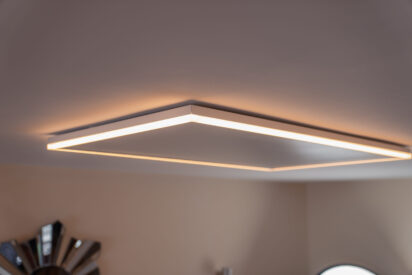
Everyone knows that heat rises… right? Sort of, Heat doesn’t rise on its own, what actually rises is hot air, which carries heat with it. This means that by bypassing the air, there actually is a way to point a heater downwards and see positive results.
In this post, we break down the science behind FIR heating, show why ceiling panels can outperform conventional heaters, and explain how to position them for maximum comfort in any room.
How Does A Convection Heater Work?
As the name suggests, traditional heaters heat a room through convection.
For example, hot water/oil will flow around a standard convection heater, so the surface temperature increases enough to heat up the air around it.
As the air gets hotter, it rises upwards and begins to move across the ceiling.
After moving for long enough, the air will cool down and begin to sink back down to the floor, where it heats up again.
This cycle continues until the radiator is turned off, or a door/window is opened letting all the heat out.
How Is The Science Behind A FIR Heater Different?
FIR heaters heat objects, walls and people almost instantly.
How does this work when air takes time to travel?
FIR heaters take advantage of a completely different heating method: instead of heating the air with a hot surface temperature, they emit tiny far infrared rays in every direction (aside from backwards, the rear of a Warm4Less ceiling panel won’t exceed 8°C.)
FIR rays travel until they hit a surface, which absorbs the energy and warms up, eventually radiating heat into the room.
Surfaces get hotter with every bounce until they get so warm that they radiate heat of their own, warming up the ambient air temperature in the room.
FIR heating heats you first and the air second as a by-product so you can feel warm before the room catches up.
Benefits of Ceiling-Mounted FIR Panels
Having your heating on the ceiling comes with plenty of benefits ranging from your convenience, health benefits and saving on your bills.
The most notable advantages to using ceiling-mounted FIR heaters are:
- Low wattages – due to the unique heating method, roughly 900W of FIR heat can substitute for 2000W of convection heat (depending on insulation, ceiling height and usage.)
- Heat spread – ceiling mounting provides more even coverage around the whole room, as opposed to having heaters on one wall; both methods will heat the whole room but ceiling mounting will be much more efficient.
- Out the way – utilise your unused ceiling space to make the most of your valuable wall space.
- Suspending – most ceiling-mounted heaters can be suspended to prioritise lower areas and not lose any heat to the void above.
- Not lost to draughts – opening a door with a convection heater turned on will mean all the hot air escaping but as FIR is a radiant type of heat, you will still feel warmth with a window/door open.
- Ceiling grid compatibility – some ranges (like our Eco Ceiling heater) slot perfectly into a 600x600mm/600x1200mm ceiling grid matrix.
- Health benefits – FIR is proven to have a multitude of health benefits including; improved blood circulation, better sleep quality and even reduced joint pain/stiffness.
Conclusion
At first glance, mounting your heating on the ceiling seems unconventional and possibly even silly but that’s only the case with a typical convection-based heater, not a FIR panel. The fact it is a radiant heat means that not only is ceiling-mounting possible, but the optimal position in terms of heat spread and efficiency.

Written by Ethan
The Right Heater For You
Find the best heater for you with our infrared heating calculators.
Find now